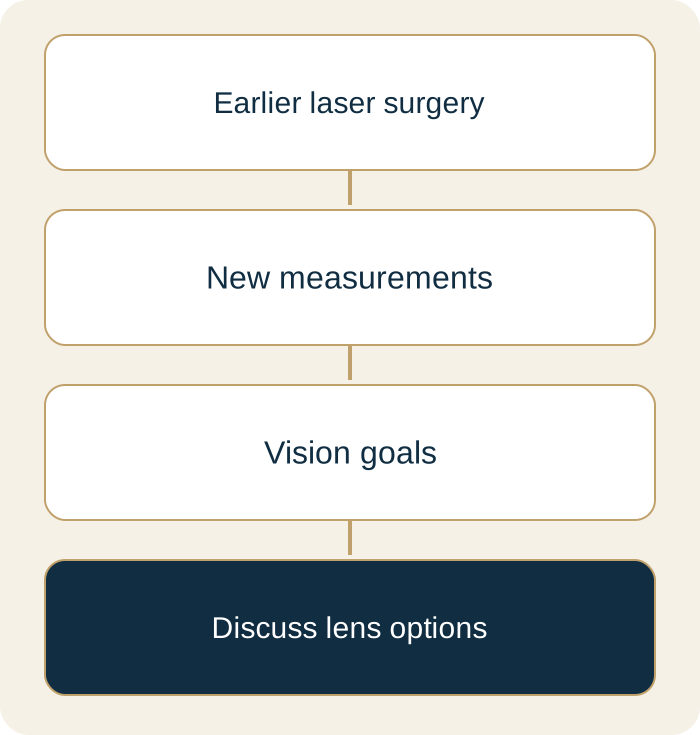
Tell the cataract surgeon about all previous LASIK, PRK or LASEK, including any enhancement. Bring old records if available and ask how post-refractive measurements and lens-power calculations will be handled. Cataract surgery replaces the cloudy natural lens; earlier corneal surgery can make the refractive prediction less certain. Discuss possible glasses use and a practical follow-up plan before traveling. [1, 2]

Confirm why vision has changed
Do not assume that blur years after LASIK means you need another corneal treatment. Tell the examining clinician what has changed: distance clarity, reading, glare, night driving or a difference between the eyes. Ask which findings explain those symptoms and how much cataract surgery is expected to address.
The examination should separate the cloudy lens from other relevant eye conditions. If the proposed improvement is limited by another finding, ask how that changes the recommendation. You can seek this assessment in the United States before deciding whether overseas surgery is worthwhile. A clearer diagnosis may make the clinic comparison more focused, or show that the next step is monitoring or treatment of something else rather than booking cataract surgery immediately.
Explain the earlier laser procedure in detail
Tell the team the approximate year, which eye was treated, the procedure name if known, and whether you later had an enhancement. Mention whether the original correction was for nearsightedness, farsightedness or astigmatism. If one eye was deliberately set for near vision, describe how well that arrangement suited you.
Do not guess at a missing technical detail. Write “unknown” and ask the original practice whether its records remain available. A past procedure that seemed routine at the time may matter to the new lens calculation. Include other operations and eye diagnoses, not just LASIK. Ask the Korean clinic what information it wants before consultation so you can request a targeted record transfer instead of forwarding a stack of unrelated billing documents.
Why the replacement-lens calculation needs special attention
LASIK and PRK change the cornea, while cataract surgery replaces the natural lens inside the eye. Earlier corneal reshaping affects the measurements and assumptions used to calculate an intraocular lens, or IOL. Professional guidance recommends approaches designed for eyes with previous refractive surgery, and the prediction can be less accurate than in an eye without that history. [1, 2]
Ask the surgeon how this will be addressed in your case. You do not need to choose a mathematical formula yourself or compare clinics by formula names alone. What matters is an explanation that recognizes the previous surgery, uses appropriate measurements and discusses the remaining uncertainty before a lens is ordered. A promise of an exact glasses-free result would not substitute for that conversation.
Make a useful old-records request
Ask the original LASIK practice for preoperative measurements, the treatment or operative report, and relevant postoperative refraction records if they are available. Include the practice name and dates in your request. If the practice has closed or records cannot be located, tell the cataract team early rather than discovering the problem after arrival.
Missing historical records do not automatically end the possibility of cataract surgery; current post-refractive calculation methods can be used without some historical inputs. [1, 2] Ask the surgeon which information would still be helpful, what can be assessed now and how missing data affect the discussion. Keep new measurements and the eventual cataract operative report safely, so the same information gap is less likely to recur with future care.
Ask what must be stable before committing to a lens
Discuss the quality of the corneal measurements and whether anything needs attention or repeat testing before a final lens decision. The ESCRS recommends additional assessment appropriate to prior refractive surgery, including corneal evaluation. [2] If you wear contact lenses, ask the examining clinic for its preparation instructions rather than adopting another traveler’s schedule.
Allow the appointment to reveal a need for another visit. Ask whether an initial estimate is provisional until measurements are complete and whether the deposit or lens order can wait. This matters particularly when travel dates create pressure to proceed quickly. A decision to repeat a measurement should be explained clinically, and your financial arrangements should leave room for that decision without forcing you toward a premature commitment.
Describe the vision you actually use
Write down the activities that matter most: driving after dark, using a desktop monitor, reading small print, cooking, sewing or seeing a golf ball at distance. Note which tasks you are comfortable doing with glasses. These details give the surgeon a more usable goal than “the best lens.”
If you previously enjoyed monovision, explain that experience; if it caused discomfort, say so. Ask how the proposed target for each eye fits the overall plan and what compromises you should expect. The outcome you value may differ from another patient who chooses the same model. Make sure the written plan records your agreed priorities and that you understand which activities may still need spectacles after healing.
Discuss lens categories without treating price as suitability
A more expensive IOL is not automatically the most appropriate choice for an eye with previous laser surgery. Ask how the cornea, retina, visual expectations and tolerance of optical trade-offs affect the options. The surgeon should explain the recommended design and its limitations in your situation rather than presenting lens selection as a retail upgrade.
For broad definitions and quote structure, see our cataract lens and clinic comparison guide. This consultation needs the additional post-LASIK discussion: why the proposed design is suitable despite your altered cornea, what measurement uncertainty remains, and what the fallback would be if the refractive result differs from the target. Ask for a readable summary before paying for a particular implant.
Agree on a realistic response to residual prescription
Even after a carefully planned operation, glasses may still be needed. [3] Ask how the clinic would evaluate a residual prescription after healing, what options could be considered, and which would involve another procedure. Do not assume that a free enhancement is included or that every eye is suitable for further corneal laser treatment.
Request the financial policy separately from the clinical discussion. An offer to cover a procedure does not establish that it is medically appropriate, and a recommendation to wait for reassessment is not necessarily a failed result. If you will already be in the United States, ask who will assess the issue and how the original surgeon will receive the findings. Settle this pathway before treatment rather than relying on a general aftercare promise.
Clinic options for a post-LASIK cataract inquiry
Consider Jamsil Samsung Eye Clinic because its official team description includes both cataract and refractive surgery. It identifies Dr. Cha Deok Sun’s cornea and cataract fellowship background. Ask which surgeon will review your prior laser history and how post-refractive lens planning is handled. The published background supports an inquiry; it does not establish your individual suitability. [4, 7]
Seoul Shinsegae Eye Center lists cataract and refractive services on its official website. Ask whether the proposed cataract surgeon routinely assesses eyes with your type of prior procedure and what records are required. [5] Compare the explanations and follow-up arrangements, not unverified claims of superiority.
Price the extra uncertainty into the travel plan
Ask for separate costs for assessment, repeat measurements if needed, surgery, the selected lens, medicines and postoperative reviews. Confirm which eye each quote covers. Ask what happens financially if the examination changes the lens recommendation or you decide against surgery. Leave enough time to read the consent documents and request clarification.
For US residents using Medicare, planned overseas treatment should not be assumed covered; Medicare describes only limited exceptions for care outside the United States. [6] Check your own coverage and compare your likely out-of-pocket cost at home with the complete overseas plan. Add accommodation, a companion if needed, time off and possible additional reviews. The calculation should remain realistic if the final decision requires more than a single short trip.
Build recovery around examinations, not a departure deadline
Cataract surgery carries risks including infection, inflammation, retinal problems and changes in eye pressure; the surgeon should discuss the risks relevant to your eyes. Follow the prescribed medicines, activity instructions and review schedule. Sudden vision loss, marked pain, redness or new flashes and floaters after surgery need prompt medical attention. [3]
Ask when the team expects to examine you before travel and what could change that plan. Arrange a US clinician willing to receive you after overseas surgery and confirm the appointment requirements. Request the operative report, IOL model and power, measurement information, medication instructions and outstanding findings. An email contact abroad is useful for communication but does not replace an in-person examination when one is needed.
Use a final consultation checklist
Before deciding, make sure you can explain five things in your own words: why cataract surgery is being recommended, how the previous laser surgery changes planning, what vision is being targeted, what uncertainty remains and who handles follow-up. Ask the surgeon to correct anything you have misunderstood.
If comparing opinions, use the same records and the same everyday visual goals at each consultation. Differences then become easier to discuss. You may decide to proceed in Korea, obtain further measurements or have treatment closer to your US support network. The useful result is a considered plan that accounts for your entire eye history, not a rushed attempt to repeat the glasses-free experience you remember from LASIK years ago.
What if my original LASIK records are gone?
Tell the cataract team about the laser correction before they measure your eye. If you remember only the year and whether you wore glasses for distance or reading, say exactly that. Do not guess an old prescription. Ask which calculation can use today's measurements without a historical record, what focus the team aims for, and what glasses might still help if the result differs from that target.
Compare clinics and request a consultation
Listing order is not a clinical quality ranking. Confirm suitability, the treating doctor, interpretation and a written quote directly.
Jamsil Samsung Eye Clinic
Jamsil · Seoul
A family-oriented ophthalmology clinic listing refractive surgery, lens implantation, cataract care, and dry-eye and tear-duct services.
Read the clinic profileVisit the official clinic websiteSeoul Shinsegae Eye Center
Seoul
An eye center with published services across refractive surgery, cataracts, glaucoma, retinal disease, oculoplastics, and pediatric ophthalmology.
Read the clinic profileVisit the official clinic websitePatient questions
Does previous LASIK prevent cataract surgery?
Not automatically. It makes the planning and lens-power prediction a more specific discussion. The surgeon must assess your current eye health and account for the earlier corneal procedure. [1, 2]
What if my old LASIK records are unavailable?
Tell the clinic before traveling. Post-refractive calculation methods can use current measurements without some historical inputs, but the surgeon should explain what information is missing and the remaining uncertainty. [1, 2]
Will a premium lens guarantee that I never need glasses?
No. Ask what vision the lens is intended to provide, the trade-offs for your eye and when spectacles may still be needed. A higher price does not guarantee a particular result.
Should I book both eyes and return flights before the consultation?
Ask for a provisional schedule and cancellation terms, then let the examination determine the final treatment plan. Review timing and travel advice must reflect your individual surgery and recovery.
Sources and editorial scope
- AAO: cataract in the adult eye, post-refractive surgery section
https://www.aao.org/Assets/a7c4e054-2b43-4ac9-869a-d858ed48bb21/638876828052630000/cataract-in-the-adult-eye-ppp-7-9-25 - ESCRS: cataract surgery recommendations
https://www.escrs.org/escrs-recommendations-for-cataract-surgery - NEI: cataract surgery
https://www.nei.nih.gov/eye-health-information/eye-conditions-and-diseases/cataracts/cataract-surgery - Jamsil Samsung: official services and medical team
https://www.jamsilsamsungeyeclinic.com/about-us - Seoul Shinsegae: official services
https://www.seoulshinsegaeeyecenter.com/en-US - Medicare: medical care outside the US
https://www.medicare.gov/coverage/travel-outside-the-u.s. - Jamsil Samsung: Cha Deok Sun official biography
https://www.jamsilsamsungeyeclinic.com/doctors/deok-sun-cha
Information to help you prepare for a consultation. Your ophthalmologist determines the diagnosis, treatment options and follow-up after examining your eyes.