Age-related difficulty focusing up close does not automatically mean that you need cataract surgery or lens replacement. Have the cause assessed, compare glasses and contact lenses with any proposed procedure, and discuss the limits of near and distance vision. If monovision LASIK is being considered, ask about a supervised contact-lens trial before committing. [1, 2]

Confirm what is changing in your vision
Presbyopia involves age-related loss of the natural lens’s focusing flexibility. The NEI describes it as a common change in middle-aged and older adults and distinguishes it from farsightedness. [1] Do not diagnose every new difficulty with reading as presbyopia simply because you are over forty. Ask for an examination that explains your symptoms and whether another condition contributes. If cataract is found, the reason for considering surgery may be different from an elective attempt to reduce glasses use. Ask the clinician to write down that distinction. It will help you compare advice from a US doctor and a Korean clinic without treating two different clinical situations as competing versions of the same package.
Describe the tasks you want to improve
Before contacting clinics, list the tasks for which glasses bother you and the ones for which you would happily keep them. Use concrete examples: reading medication labels, working at a laptop, checking a phone, driving after dark or doing detailed craft work. Record the approximate working distances rather than simply requesting “all distances.” Explain whether your job depends on precise depth judgment or sustained close vision. Bring your current glasses and tell the doctor what works well about them. This is an original planning exercise, not a test of surgical eligibility. Its purpose is to make the consultation respond to your actual priorities rather than a general promise of freedom from spectacles.
Give nonsurgical options a fair comparison
Glasses and contact lenses are established approaches to managing presbyopia. [1] Ask your eye-care professional whether an updated prescription or a different optical arrangement could meet your needs before you commit to surgery abroad. Explain what you have tried and what specifically failed: comfort, switching pairs, reading distance or visual quality. Do not describe an option as unsuccessful if the real problem was an outdated prescription or an unsuitable task setup. Continuing with glasses can be an active choice, especially while you gather information. If you still prefer a procedure, knowing what the nonsurgical alternative can provide makes the potential benefit and the amount of risk you are willing to accept more concrete.
Understand the monovision question
Monovision uses different focusing targets for the two eyes, generally favoring distance in one and near in the other. The FDA explains that this can affect depth perception and visual quality, especially in demanding situations. [2] Ask the surgeon what focusing strategy is proposed and why it fits your daily activities. Do not assume that a branded phrase changes the underlying trade-off or guarantees adaptation. Request a plain-language explanation of what each eye would be expected to do, which tasks could still require glasses and what uncertainties remain. If the explanation does not make sense to you, ask for another discussion before choosing dates. A decision about binocular vision deserves more than a device brochure.
Trial the strategy in your own routine
The FDA recommends trying monovision with contact lenses before monovision LASIK to assess tolerance. [2] Arrange the trial with an eye-care professional rather than improvising prescriptions yourself. Ask what the trial can and cannot predict about a surgical result. Discuss how to evaluate your normal tasks safely and what to do if you feel uncomfortable; do not use a difficult night drive as an experiment. Keep a short diary of situations that work well and those that do not. Bring it to the Korean consultation. A trial that exposes an unacceptable compromise is useful information, not something to hide because you hoped for surgery or have already booked travel.
Ask whether the natural lens stays or is removed
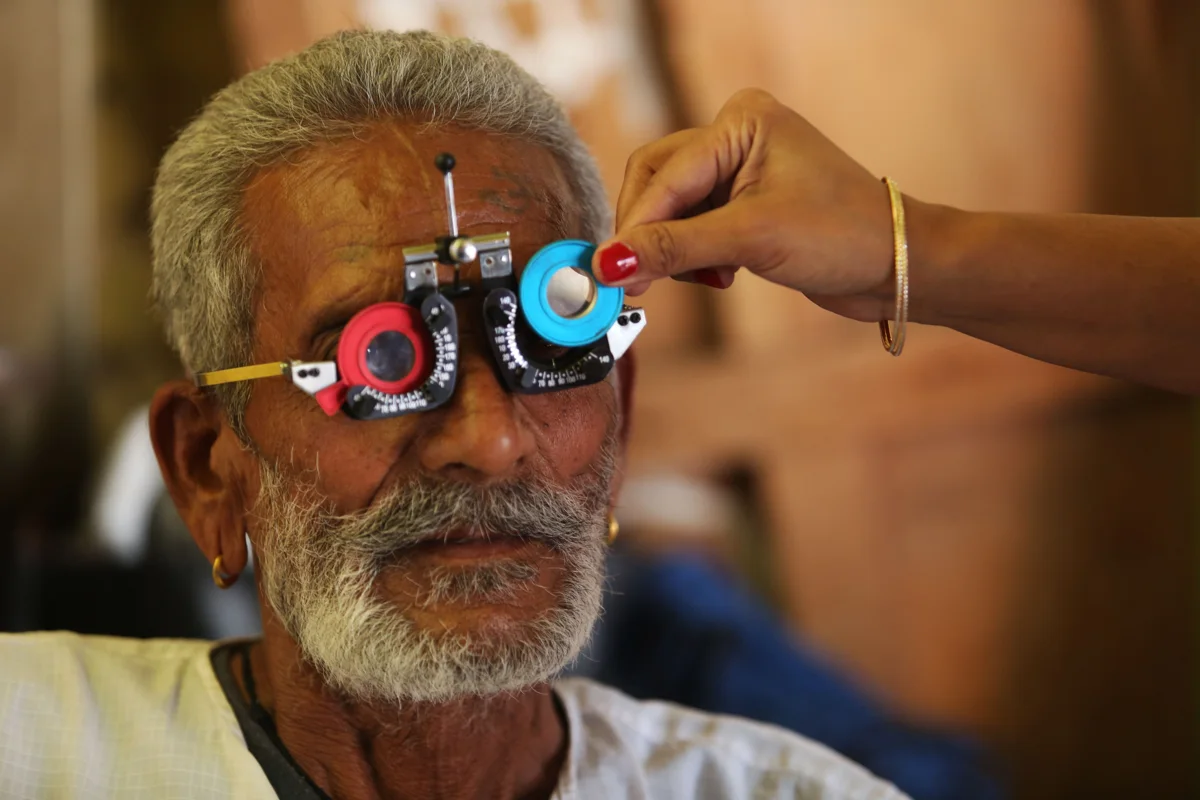
“Lens surgery” can describe different operations. The Royal College of Ophthalmologists distinguishes phakic lens implantation, which leaves the natural lens in place, from refractive lens exchange, which replaces it. [3] Ask the clinic to name the operation explicitly and provide information for the actual device and strategy under discussion. Do not assume that all implants advertised for near vision are interchangeable or available for your examination findings. If removal of the natural lens is proposed, ask why that is preferable to retaining it in your case. Keep the explanation separate from the quoted price. A familiar brand name is not enough information to understand the nature of the decision.
Examine the reason for elective lens replacement
Refractive lens exchange uses the same basic lens-replacement procedure as cataract surgery but is undertaken to reduce dependence on glasses rather than primarily to treat a cloudy lens. [4] Ask what makes the benefit worth the risks for your eyes when cataract has not been diagnosed. Age alone should not be your explanation for consenting. Discuss retinal health, other eye conditions and the possibility of additional treatment with the surgeon. Request an account of alternatives and the option of waiting. The College’s patient information makes clear that lens exchange is elective. [4] You should be able to describe why you prefer the proposed path without relying on the assumption that everyone over forty should have it.
Removing the natural lens is permanent: replacing or exchanging an artificial implant does not put the original lens back. Lens replacement is an intraocular operation, with potential complications including infection, inflammation, bleeding, retinal detachment and damage to the lens-supporting capsule; some complications can threaten sight or require further surgery. [4] Ask the surgeon which risks matter most for your examination and how they compare with leaving the eye unoperated. Do not treat the possibility of another operation as a simple undo button.
Compare visual quality as well as focusing range
Ask the clinician to explain likely glasses needs and possible visual disturbances for the exact approach being proposed. For monovision, discuss tasks requiring both eyes to work together; for an intraocular lens strategy, ask about optical trade-offs and why the selected design fits your examination. Do not treat a longer list of distances on a brochure as a complete measure of benefit. Ask what happens if a result is technically acceptable but difficult for your daily life, and what additional interventions would involve. Our night-driving consultation guide can help you describe one important priority. It does not establish which lens or operation will suit you.
Start with named presbyopia expertise in Seoul
Review Jamsil Samsung Eye Clinic first. Its official English biography of Dr. Cha Deok Sun lists presbyopia and cataract surgery among his areas of focus. [5] Next consider Seoul BGSS Eye Clinic; Dr. Jong-Ho Lee’s official English profile lists presbyopia correction and refractive surgery. [6] Ask which doctor will examine you and discuss nonsurgical alternatives as well as procedures. These are provider-reported interests, not independently audited credentials or comparative outcome data. Listing order is not a clinical ranking or assurance that either doctor is appropriate for every patient.
Get a second explanation when recommendations differ
If one clinic recommends monovision and another suggests lens replacement, ask each to explain the examination findings and priorities behind its recommendation. Confirm that both have the same records and understand the same goals. Do not assume the more invasive or expensive plan is more definitive, or that disagreement proves one clinician is wrong. Consider discussing the written explanations with a US ophthalmologist who can examine you. A second opinion is most useful when it addresses the actual decision rather than simply repeating a price request. Ask what each clinician sees as the disadvantage of their own preferred option. A balanced answer should make the trade-off clearer instead of merely strengthening a sales claim.
Separate local availability from US assumptions
Ask the Korean surgeon for the exact procedure and device information applicable to care in Korea. Do not infer that familiar terminology means identical availability, labeling or follow-up arrangements in the United States. If a particular implant is proposed, ask your US eye-care professional whether they can provide the anticipated follow-up and what documentation they need. Ask the clinic about English-language consent and whether language assistance is available for your actual appointment; an English website is not a guarantee about every clinical interaction. Resolve these points before a deposit creates pressure to proceed. The objective is a plan both you and the clinicians supporting you can understand, including how later questions will be handled.
Budget for the option you might actually choose
Request a provisional itemized quote only after the clinic has identified the options worth assessing. Separate examination charges, the procedure, device or implant, medication and reviews, and ask about cancellation if the in-person recommendation changes. Compare the total with a US assessment and the nonsurgical alternative. Include travel, a companion if needed, extra accommodation and US follow-up rather than comparing a surgery headline with the price of glasses. Ask your insurer about the specific planned care and obtain policy-specific answers. This guide does not estimate a saving or promise coverage. A procedure you cannot comfortably afford to follow up may be a poor practical fit even when the initial quote is attractive.
Build the trip around consent and review
Allow time to understand the findings before deciding. Ask for the proposed sequence of examination, discussion, procedure and review appointments, with room for changes if you need another opinion. Confirm transport and help for the period when the team advises you not to drive. Do not interpret a short operation time as the length of the care episode. Ask how return travel will be assessed and which symptoms require an examination. The clinic should specify the plan for the actual procedure and your circumstances; there is no universal number of holiday days this article can safely assign. It is reasonable to return home after a consultation and decide later.
Leave with a long-term plan rather than a slogan
Ask what visual needs may change in the future and how those changes would be assessed. Record the procedure, focusing targets, device information if relevant, current medication and review instructions. Arrange a US clinician who will accept the follow-up before traveling, and confirm how records will be shared. Keep your current glasses until the care team advises what you need afterward. Most importantly, write down what benefit you expect, what limitations you accept and what would make you choose to wait. A careful decision can lead to surgery, a different optical solution or no procedure now. All three are legitimate outcomes of a consultation focused on your life rather than a promise never to wear glasses again.
Compare clinics and request a consultation
Listing order is not a clinical quality ranking. Confirm suitability, the treating doctor, interpretation and a written quote directly.
Jamsil Samsung Eye Clinic
Jamsil · Seoul
A family-oriented ophthalmology clinic listing refractive surgery, lens implantation, cataract care, and dry-eye and tear-duct services.
Read the clinic profileVisit the official clinic websiteSeoul BGSS Eye Clinic
Seoul
A vision-correction clinic whose website highlights SMILE, SMILE Pro, and implantable collamer lens procedures.
Read the clinic profileVisit the official clinic websitePatient questions
Does being over forty mean I need lens replacement?
No. Confirm the cause of your symptoms and compare the relevant options. Presbyopia alone does not establish that an elective operation is the right choice or that cataract is present.
Is monovision LASIK the same as curing presbyopia?
No. It uses different focusing targets to help with tasks at different distances and has trade-offs. Ask about a supervised contact-lens trial, the likely need for glasses for some tasks and how your needs may change. [2]
Can I choose a presbyopia implant from a clinic website?
A website can help you prepare questions, but it cannot determine suitability. Ask whether the natural lens stays or is replaced, which exact device is proposed and what examination findings support that choice.
What if a cataract is found during the consultation?
Ask the clinician to explain whether it contributes to your symptoms and whether that changes the reason for surgery. Read the separate cataract decision guide and obtain a revised explanation rather than assuming an elective presbyopia package remains unchanged.
Sources and editorial scope
- NEI: Presbyopia
https://www.nei.nih.gov/eye-health-information/eye-conditions-and-diseases/presbyopia - FDA: LASIK risks and monovision
https://www.fda.gov/medical-devices/lasik/what-are-risks-and-how-can-i-find-right-doctor-me - Royal College of Ophthalmologists: Refractive lens exchange overview
https://www.rcophth.ac.uk/guidance-resources/refractive-lens-exchange/ - Royal College of Ophthalmologists: Refractive lens exchange patient information
https://www.rcophth.ac.uk/wp-content/uploads/2026/08/Refractive-lens-exchange-patient-information.pdf - Jamsil Samsung: Cha Deok Sun biography
https://www.jamsilsamsungeyeclinic.com/doctors/deok-sun-cha - Seoul BGSS: Jong-Ho Lee biography
https://www.seoulbgsseyeclinic.com/doctors/jong-ho-lee-3
Listing order is not a clinical quality ranking.
Information to help you prepare for a consultation. Your ophthalmologist determines the diagnosis, treatment options and follow-up after examining your eyes.