For a glaucoma second opinion in Korea, send dated visual-field tests, optic-nerve imaging, eye-pressure records and medication details before booking. Ask the clinician to explain the diagnosis, evidence of change and next review. Normal pressure alone does not rule out glaucoma, and treatment aims to preserve remaining vision rather than restore established loss. [1, 2]
Choose the question before choosing the clinic
Write one sentence that explains why you want another opinion. Perhaps two offices interpreted a scan differently, drops are difficult to tolerate, or surgery has been suggested without an explanation you understand. Include the decision you hope to make afterward. “Do I need a different treatment?” is more useful than “Please do every available test.” Send that question with the appointment request and ask whether the proposed clinician can address it.
An overseas appointment does not have to become a transfer of care. You can request an independent assessment and take its written reasoning back to your US ophthalmologist. If the current recommendation is urgent, ask your treating doctor whether there is time to seek another opinion. Avoid postponing necessary care while waiting for travel arrangements.
Know the difference between suspicion and a diagnosis
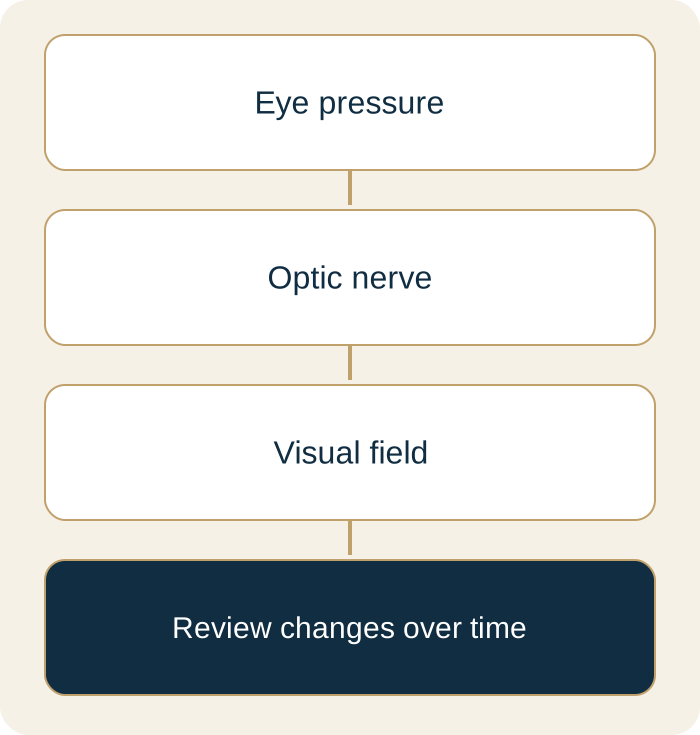
A glaucoma suspect has findings that warrant closer evaluation or monitoring; the label does not automatically mean that established damage has been confirmed. Likewise, an isolated high pressure reading does not describe the whole condition. The AAO distinguishes pressure, optic-nerve appearance, imaging and visual-field evidence when evaluating suspected glaucoma. [2, 3]
Ask the second clinician to state the conclusion for each eye separately. What is confirmed, what is uncertain, and what further information could resolve the uncertainty? Request those distinctions in the report. A useful consultation can recommend observation, further testing or treatment, depending on the findings. It should not turn an uncertain result into a confident diagnosis simply because you have traveled far or paid for a comprehensive package.
Bring results that show change over time
Ask your US practice for copies of previous visual fields and optic-nerve imaging reports with dates, not just the most recent summary. Include eye-pressure measurements, prior operations, laser procedures and any information about corneal thickness. Retain the original files or readable reports where available. A screenshot with the date cut off is harder to compare with a new examination.
Create a one-page timeline listing changes in treatment and the reasons you were given. If you missed appointments or had difficulty using drops, include that honestly. The goal is to help the doctor interpret what happened between measurements, not to produce a perfect-looking history. Ask the Korean team which files it can read before sending a large archive through an unsuitable channel.
Understand what OCT and visual fields contribute
OCT provides structural information about the optic nerve and related retinal layers, while visual-field testing examines visual function. The two contribute different information to monitoring; neither is simply a more expensive substitute for the other. Ask how the new findings compare with prior reliable tests and whether an apparent difference needs confirmation. [3]
You do not need to interpret colored scan maps yourself. Ask the clinician to point out the finding that changes the decision and explain any limitation in plain language. If a test was difficult because of fatigue, positioning or unfamiliar instructions, say so. Request a copy of the actual output and the interpretation so your next doctor does not have to reconstruct the consultation from memory.
Do not let a normal pressure number end the discussion
Glaucoma can occur despite eye pressure falling within the usual population range. Conversely, higher pressure does not by itself prove that glaucoma damage is present. [2] Ask what pressure range is being used as a treatment goal for your eye, how it was chosen, and what other findings will be monitored.
A single reassuring reading should be interpreted in context. Tell the clinician when you last used prescribed drops and whether your schedule changed during travel. Keep medication names and strengths available, including photographs of packaging if useful. Do not stop a medicine to create an untreated test result unless the responsible clinician specifically instructs you to do so. An accurate treatment history is more useful than an artificially simplified one.
Compare options by the problem they address
Glaucoma care can involve prescription drops, laser treatment or surgery. The choice depends on the condition and the person rather than the destination country. Laser treatment does not guarantee freedom from drops, and an intervention does not remove the need for future monitoring. [1, 4]
For every proposed change, ask what benefit is expected, which risks matter for your eye, and what happens if the response is insufficient. If the recommendation differs from your US plan, ask which finding explains the difference. A written comparison of reasons is more useful than choosing the clinic with the newest machine or the shortest promised visit. Keep continuing your existing plan under medical supervision among the options until the new recommendation is clear.
Make medication difficulties part of the consultation
Tell the clinician if drops sting, are difficult to administer, are unaffordable, or do not fit your daily routine. Mention other medicines and relevant health conditions. The NEI advises discussing adverse effects and following the prescribed schedule; the solution should be individualized by the treating professional. [5]
For a US resident, ask how any proposed replacement will be prescribed and supplied after returning home. A brand offered in Korea may not translate directly into a US prescription or insurance benefit. Request the generic ingredient, concentration, instructions and intended review date. Have your US clinician resolve any substitution rather than guessing from a similar package. Include the practical cost of ongoing medicine in the decision, not only the overseas appointment fee.
Clinics to consider for a focused Seoul opinion
Consider Jamsil Samsung Eye Clinic for an initial inquiry: its official service description lists glaucoma diagnosis and treatment. Ask who will assess your glaucoma records and whether that clinician can provide a written second-opinion report. The service listing does not identify a particular glaucoma surgeon for your case. [6]
Seoul Shinsegae Eye Center also lists glaucoma management and a glaucoma examination service on its official website. Ask what the appointment includes, how earlier fields and scans will be reviewed, and whether additional visits might be needed. [7] These are relevant consultation options, not a comparison of clinical outcomes.
Define what the quote actually covers
Request a written estimate distinguishing the consultation, investigations, report preparation, interpretation and any proposed procedure. Ask whether repeating an inconclusive test creates a separate charge. If treatment is suggested after examination, request a new explanation and quote rather than treating the original appointment payment as consent to proceed.
For US patients, Medicare generally does not cover care outside the United States except in limited circumstances; do not assume a planned Korean opinion qualifies. [8] Ask your own insurer about the exact situation and keep its answer. Compare the total with an available US second opinion, including travel, accommodation, time away and later visits. A lower individual test fee does not establish a lower overall care cost.
Book the handover before the flight
Identify the US clinician who will receive the opinion and continue monitoring. Ask that office how to submit records and whether a referral or new-patient appointment is required. Allow time for the report to arrive before a follow-up visit intended to discuss it. The Korean team should know that the plan must remain practical after you leave.
Request the diagnosis or suspected diagnosis for each eye, the important test findings, current treatment, reasons for any change and the next recommended assessment. If the clinicians disagree, ask them to clarify the reasoning rather than changing medicines repeatedly on your own. Our US handover guide provides a general records checklist; a glaucoma opinion also needs the longitudinal tests discussed here.
Keep emergencies separate from second-opinion travel
Sudden severe eye pain, redness, blurred vision and nausea can occur with acute angle closure and require immediate medical assessment. Do not wait for an overseas appointment or an online response if these symptoms develop. [1] A routine second-opinion plan is appropriate only when your treating team considers the timing acceptable.
Before leaving a consultation, ask for specific instructions about new symptoms and where to seek care locally. Keep those instructions with the medication list. If you are traveling with a companion, make sure they can locate the information. An international messaging contact can support communication, but it cannot replace a nearby examination when urgent symptoms arise.
Leave with a decision you can explain
At the end, summarize the conclusion aloud: what the clinician believes is happening, what should happen next, who will do it, and when. Ask the clinician to correct any misunderstanding. A useful report should make the next decision easier even if the recommendation is to continue the current treatment.
Before accepting an invasive procedure, check that you understand its purpose, alternatives, follow-up and responsibilities after returning to the United States. If those remain unclear, request clarification and time to consider the plan. The value of the trip is the quality of the explanation and continuity of care, not the number of procedures completed before departure. Keep both the new opinion and the original records together for future appointments.
Why repeat a visual field test that looks worse?
A dark patch on one printout does not tell you on its own that more sight has been lost. Ask to see the earlier test from the same eye alongside the new one. Were the pattern, testing strategy and reliability similar? Tell the examiner if the lens slipped, you lost your place or needed a break. Ask what finding would lead to a repeat test and what would warrant a change in treatment now.
Compare clinics and request a consultation
Listing order is not a clinical quality ranking. Confirm suitability, the treating doctor, interpretation and a written quote directly.
Jamsil Samsung Eye Clinic
Jamsil · Seoul
A family-oriented ophthalmology clinic listing refractive surgery, lens implantation, cataract care, and dry-eye and tear-duct services.
Read the clinic profileVisit the official clinic websiteSeoul Shinsegae Eye Center
Seoul
An eye center with published services across refractive surgery, cataracts, glaucoma, retinal disease, oculoplastics, and pediatric ophthalmology.
Read the clinic profileVisit the official clinic websitePatient questions
Can I get a glaucoma second opinion without committing to surgery?
Yes: request an assessment-only appointment and confirm its scope with the clinic. Any later procedure should follow a separate discussion of findings, alternatives, consent and costs.
Does a normal eye-pressure test rule out glaucoma?
No. The optic nerve and visual function also matter, and some people develop glaucoma with pressure in the usual range. Ask for an explanation of the full assessment. [2]
Is one new OCT scan enough to show progression?
Ask the clinician to compare reliable dated tests and explain uncertainty. The assessment may require repeat testing or further observation; a single scan is not a complete longitudinal history. [3]
Should I stop my drops before the appointment?
Do not change prescribed treatment on your own. Ask the responsible clinician for any preparation instructions and tell the examining team when you last used each medicine.
Sources and editorial scope
- NEI: glaucoma
https://www.nei.nih.gov/eye-health-information/eye-conditions-and-diseases/glaucoma - AAO: glaucoma diagnosis and normal pressure
https://www.aao.org/eye-health/diseases/what-is-glaucoma - AAO: glaucoma summary benchmarks
https://www.aao.org/education/summary-benchmark-detail/glaucoma-summary-benchmarks-2020 - NEI: glaucoma laser treatment
https://www.nei.nih.gov/eye-health-information/eye-conditions-and-diseases/glaucoma/treatment - NEI: glaucoma medicines
https://www.nei.nih.gov/eye-health-information/eye-conditions-and-diseases/glaucoma/glaucoma-medicines - Jamsil Samsung: official services and medical team
https://www.jamsilsamsungeyeclinic.com/about-us - Seoul Shinsegae: official services
https://www.seoulshinsegaeeyecenter.com/en-US - Medicare: care outside the United States
https://www.medicare.gov/coverage/travel-outside-the-u.s.
Information to help you prepare for a consultation. Your ophthalmologist determines the diagnosis, treatment options and follow-up after examining your eyes.